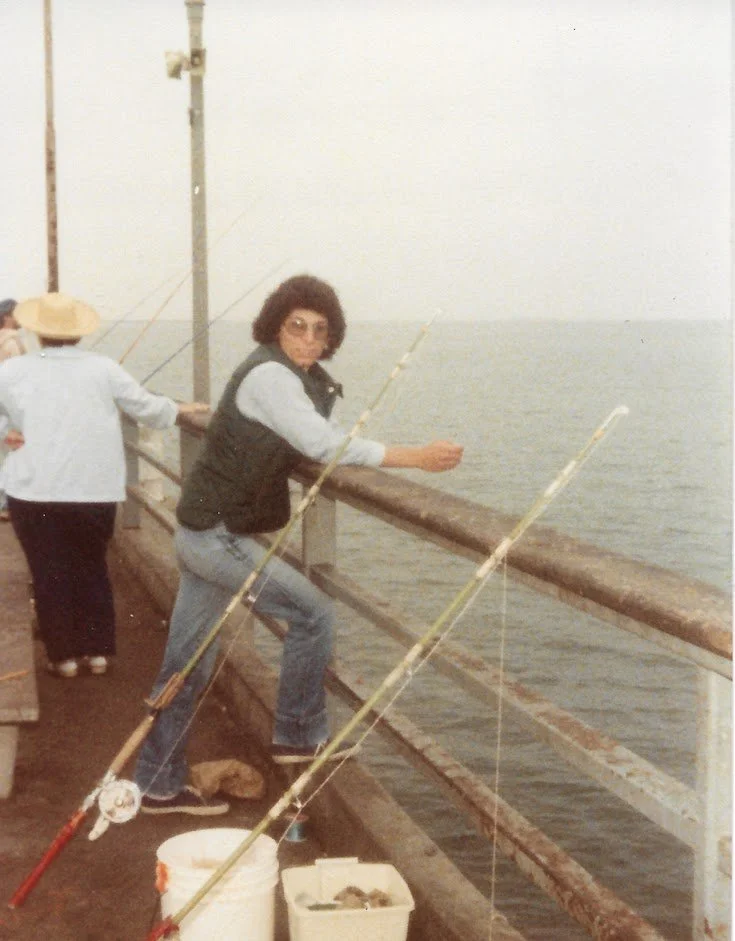
Hikayat al Bahr
My family is indebted to the Sea. Bound to her.
My great-grandfather, Ahmed Mousa Albahri, was born in a small, ancient Canaanite fishing village 24 kilometers south of Haifa called Tantura, Palestine, during the rule of the Ottoman Empire—a village perched over the sea, elevated on a low limestone hill overlooking two small bays and four lush, teardrop-shaped islands: Fallutiyeh, Shaddadieh, Iamar, and Hamam nestled in a sleepy turquoise lagoon.
Beneath the shallow surface, fresh water springs bubble forth through the saltwater. It is there that a groom’s ceremonial bath takes place in preparation for his wedding day. His family and friends lead him into the water, sing to him, and bathe him. The sea is the medium of transformation for our men, carrying them from boyhood into manhood—a liminal element that decides fate and passage. Any man who drowns and survives to tell his children is a man chosen for a great destiny. His lungs are kissed by salt, purified, and he breathes a new life, born from the great womb of the Mediterranean, our first mother. Now he is blessed with two mothers who watch over him.
My great-great-grandfather Musa and his brother Issa were skilled fishermen. The people of Tantura gifted our family the name Albahri, and they became known as the Albahri brothers who fished the seas. Musa married Mariam in Tantura, and together they were blessed with three daughters—Sabina, Thuljah, and Manwah—and one son, Ahmed.
My great-grandfather Ahmed grew up swimming with his friends between the islands while his father fished nearby. I grew up listening to their stories—great tales told by my father and uncles, men who revered them and their resilience. I call these oral narrations Hikayat al Bahr: the stories passed down by the men in my family, brined with joy, redemption, transformation, and survival. Through generations, we have inherited, upheld, and proudly passed on our fishing traditions.
One tale is told more than any other at our table.
It is the story of the day Jiddo Ahmed, swimming with his friends near the islands, encountered a great rusted-orange octopus. She entangled her long tentacles around his boyish body, latching her suckers into his skin, fusing them together as one. She submerged him beneath the waves and pulled him down like an anchor. My father describes her as massive and powerful, a highly intelligent being that roamed the Mediterranean, a skilled hunter, and a protective mother.
Jiddo Ahmed’s friends managed to drag his limp, lifeless body back toward the shore, she still attached to him. The boys struggled under the weight of both bodies, fighting to keep his head above water. Villagers ran towards the shore and attempted to separate him from her grasp, but she held on relentlessly until they were forced to pour boiling water over them both. Only then did she finally release him and retreat back into the sea.
For our people, this was not an accident but written.
The Canaanites believed in the ancient god Yamm, who represents chaos—an untamed natural force that can give and take life and demands submission. Palestinian fishermen know this law well. The only force I have seen my father bow to, and he is indeed a proud Sayad (fishermen). We love and revere the sea deeply, and with that love comes fear—fear of her untamed beauty and her power to pull us under. As proud as we are, we respect this great force that humbles us and reminds us of our fragile mortality.
Jiddo Ahmed lay unconscious and was pronounced deceased by the people of Tantura. The Sheikh of Tantura, a man from Beit Hindi who became his mentor and father figure after the Spanish Flu of 1918 that made him an orphan and wiped out his family, prepared his janazah. They cleansed his skin, wrapped him in white gauze, and prepared to bury him in the cemetery alongside his parents and three sisters.
My father tells me that Jiddo Ahmed miraculously opened his eyes moments before his burial and rose from the dead.
Had he been buried that day, our family line would have been forever severed. Ahmed was the last surviving member of his family after the pandemic that swept through Palestine.
It was the sea that took his life and returned it to him, rebirthing him from a mere boy into a young man.
It was the same sea that later swept him away from the port of Haifa during the Nakba in 1948, harboring him for a lifetime in exile. He was violently ethnically cleansed from his land and driven into the sea at gunpoint by the Haganah alongside his wife, Fatima, and their four children. My grandfather Mousa, who was seventeen at the time, would later tell us that their boat was one of the last to leave Haifa. That night, a brutal storm brewed over the Mediterranean and capsized their lives. The mother was merciful enough to deliver him to Cyprus.
Years later, it was again the sea that carried my grandfather Mousa Albahri from Lebanon to Qatar on a labor boat named Jumanah, a name he would later gift to my elder sister, meaning silver pearl of the sea—a name later desecrated and taken from her in her youth by fanatic Zionists after she refused to condemn the resistance in a public forum at her university.
If you sit at the Albahri table on a sweltering summer evening, after a long day under the sun that has blushed and stained our cheeks red, you will find batata hara doused in garlic, olive oil, and green chilies, fried fresh-caught fish, drenched in tenderly squeezed hamud, and a bowl of coarse sea salt that my father and I bicker over.
“Ya Amani! Where is the salt?” as he points his large Poseidon finger to the corner of his placemat where it disappeared from his sight.
We pinch it, grind it between our fingers, and sprinkle it over our lives, supplementing our exile from the shores of Tantura—our beloved home, our throne.
I watch my two-year-old nephew Kenaan lean over the table and pinch the shards of salt between his fingers, press them to his lips, and glance up at me cheekily, his great blue-green swells for eyes. His iconic bahri ears peek out from his curly waves, and he gives out a giggle and glances around the corner with his big eyes to see if his mother is watching. He peers back at me, and pinches a second breath of sea to his lips…his only inheritance.
“Walahhhh…you are a barhi boy arent youuu”, I whisper as I pinch his dimpled cheeky little face and press my forehead against his as we dissolve and fizzle into sea foam that bubbles and that pops against our laughter.
Venus Dream
It All Begins Here
July 2013 Ramadan
I’m floating in the abyss, looking up at a brilliant and bright eight-pointed star.
Her light is pure and shines and radiates down upon my face and skin
I float in the dark abyss.
It is just me and the star. Nothing else. Nothing exists in this space but us.
I slowly begin to descend downward, away from the star.
A man's voice, deep and warm, echoes from the heavens, “منخفض…منخفض.”
He repeats over and over as I make my descent.
I’m falling slowly, and it feels like years have passed by me.
The star grows distant — her light flickering, eons away.
I can barely see her now.
A glimmer.
Then nothing.
I am alone in darkness.
I descend further, and my clothes unravel and disintegrate from me.
I’m bare. The darkness consumes me.
Lower.
Lower.
“منخفض,” the man repeats, his voice coming from all directions. North, South, East, West.
My feet finally touch the earth —
the same relief as when my toes reach the sea floor after drifting too far in deep waters.
The voice never leaves me. It does not abandon me.
Then حب blooms from my heart — sudden, immense.
It envelops me, swaddling me like an infant.
It radiates outward, forming a protective aura around my body.
I am loved.
Oh, I am deeply loved…
I close my eyes, floating in the love.
Then I gently return to the physical world.
Gentle…gentle.
I’m softly awakened by my father's footsteps creaking the floorboards in the hallway.
He is making his rounds to wake us for Fajr and Suhoor.
His face appears in the hushed night at my door frame.
“Baba..” I whisper
Imad: “نعم يا أماني؟”
“I had a dream, Baba.”
Imad: “What did you dream,يا بابا?”
“I had a dream of a bright eight-pointed star in the sky, and I was falling slowly away from it, down. A man's voice surrounded me from the heavens, repeating “منخفض”. What does منخفض mean, Baba? I never heard of this word. My clothes unraveled from me, and I was wrapped in a warm blanket once I reached the ground. I felt immense love...Love as I have never felt in my life...it wrapped me.”
The whites of my father's eyes widened in the dark, and I sensed fear as he shuddered.
Imad: “You do not know what منخفض means, حبيبتي?”
“No…I don’t know this word.”
Imad: “It means to descend…to go low….to be lowered”
“What does it mean, Baba?”
He is quiet. He pauses.
“...This dream is from Allah…You have officially begun your womanhood…Your journey…You are no longer a girl يا أماني…you will descend and go low and undergo many years of hardship and suffering..but Allah will always watch over you, guide you, protect you, and love you always…
Are you going to go through with your decision knowing this? Knowing you will suffer a great deal…”
“Yes, Baba..I will go through with my decision knowing this… What does the star mean?”
Imad: “...I see. I don’t know what the star is or means.”
He stares down at the ground solemnly.
“I respect your decision then… Come and pray the fajr with your Baba
فيقي (Rise)”
I pull my blankets off me and rise to meet him.
________________________________________________________________________________________
Many years went by, and I tried to read and find answers to what this dream meant.
My first real and substantial discovery was in
2020 during COVID, after the death of my Taita.
I used to go on night hikes by myself at around 1 am and stay out for several hours.
I’d hike through the meadows and forest till exhaustion.
I’d make my feet numb to quiet my thoughts and walk like a zombie back to my bed.
My mother hated it when I would do this, so I would turn off my location on my phone not to give her anxiety.
One night, I looked up at the sky and saw a big, bright eight-pointed star.
I downloaded the Skyscape app on my phone and discovered this was not actually a star but the planet Venus, and that she was in the evening star phase since I was able to see her after sunset.
I began to read the symbolism and significance of what the Mesopotamian, Babylonian, Greek, and Canaanite cultures spoke of this eight-pointed star (Venus).
I had come to find that the eight-pointed star represents Astarte, the goddess of love, femininity, beauty, fertility, sacred desire, war, and political power.
2023 I learn about the story of the descent of Inanna/Astarte into the underworld
2024 I make the discovery that the 8-pointed star is the same as the morning star and appears before the dawn, the Bethlehem star that guided the three wise men to Jesus. That the women of Beit Lahem tatreez the cross (representing Jesus) and four Evangelists, متى (Matthew), مرقس (Mark), لوقا (Luke), يوحنا (John) in each corner, discreetly forming the 8-pointed star, sometimes cross-stitched as flowers. And do we not see our men as flowers?
In Islam we believe Ramadan is time of year when the heavens are closest to us. The veil is at its thinnest. The right pointed star is seen as the throne of Allah and represents the gates of heaven or eight angles holding the thone of Allah. Scholars interpret this as our soul conception of the great creator and descent to earth.
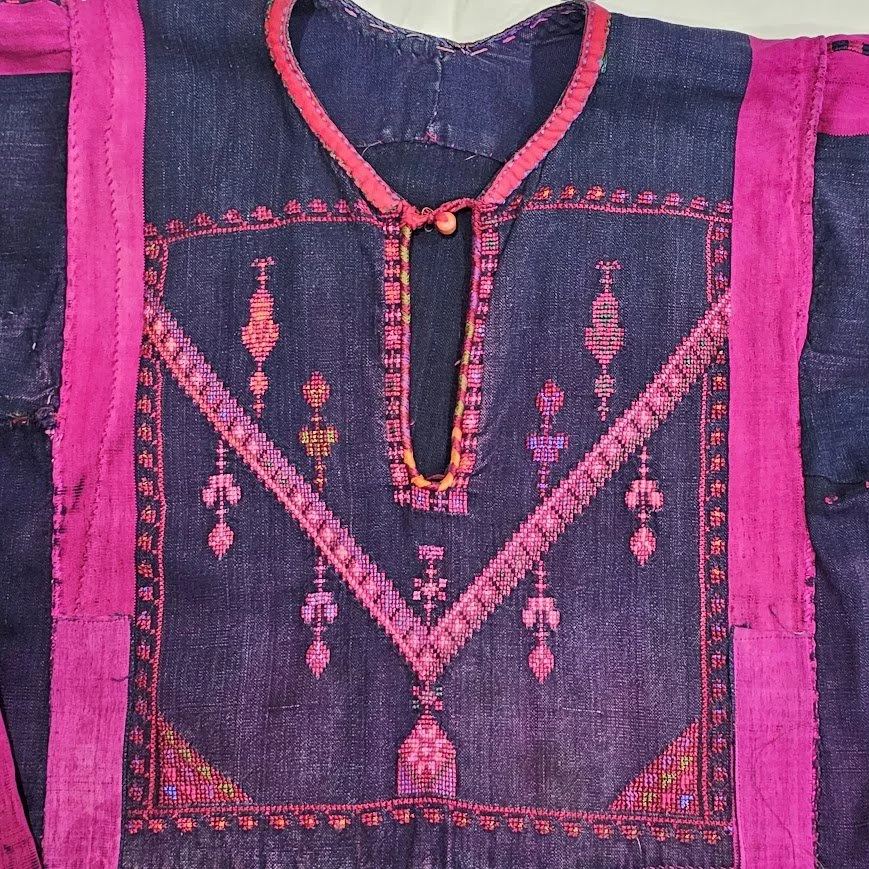
2025 I’m studying the thobes and looking over motifs. I have the Gaza thobe I retrieved from an Israeli woman lying flat on my bed.
It suddenly hits me what I’m looking at.
I trace my fingers over a deep V and an 8-pointed star amulet “Rub Al Hizb” that sits at the lowest point of the V. It is placed over the chest (قبّة) of the wearer, where the heart resides.
My heart is pounding.
Why did it take me so long to make the connection? Almost 13 years have passed.
I have been wearing thobes since I was a little girl.
My ancestors are the keepers of this knowledge.
And the descent was not abandonment. It was an initiation. Transformation.
Now I know.
What disappears will return.
What is stolen will be reclaimed.
What dies will be reborn.